

Written by Patrick Wu.
Savannah— Back on Sept. 11, Effingham County placed a 155-day moratorium on the construction of an $20 billion OpenAI center — named Project Camellia by the county — just south of the city of Rincon. The deadline for the moratorium is Feb. 16, 2027, but may be extended by up to 60 days afterwards. If built, the data center will take up 4.4 million square feet and become the largest consumer of power in Georgia’s history.
The moratorium itself was originally proposed by County District Commissioner Dean Kicklighter, District 7, and put into place on Aug. 27. According to Kicklighter, the goal of the moratorium is to, “take the necessary time to fully evaluate the issues involved.”
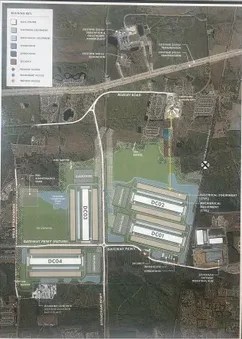
The Savannah Gateway Industrial Hub is located on the western side of Highway 21, about a 34-minute drive from the Hive dorms, or a 38-minute drive to the city hall. Relative to Rincon, the site is also adjacent to Blandford Elementary school and nearby to the Savannah National Wildlife Refuge and the Rookery and Roots Conservancy.
OpenAI’s new data center will hire 400 long-term workers on a wage of at least $80,000 for a 35 or above workweek, according to an annotated copy of the agreement from local news source The Current. Contracted workers are permitted, seasonal or temporary workers are not. The construction of the data center, including the building, machinery, and equipment used in the construction of the site are all included in the $20 billion investment Octans GA has promised to fulfill, with the value of these items calculated to market value.
Construction of the data center will occur in five phases, throughout which it will receive 15-year tax abatement — a kind of tax break — for each phase, requiring OpenAI to only pay half of the property tax’s value, with the rate affixed to 2026 rates.
The agreement itself is also called a “memorandum of understanding,” although it effectively acts as a contract by detailing the legal privileges and responsibilities of both OpenAI and the county.
Writer’s note: The source that was used here could be perceived as being particularly against the Effingham County Data Center deal. Please understand that any biases associated with the annotations do not reflect the views of SCAD District or the Current as a whole.
Outside of the written contract, OpenAI has also provided a $4.3 million grant to pay for school meals, while ECIDA has promised $30 million for the next three years to relieve property tax relief, starting fiscal year 2027. (On the Project Camellia website, this is defined as 2 mills of relief, a mill defined as the value of a property divided by a thousand. This comes out to six mills of property tax relief over the three years.) Projections display $32 million annually to direct tax revenue to the operating budget of Effingham County’s school budget and $10.2 million in annual dedicated funding for education.
Georgia Power will be responsible for serving 3.2 gigawatts of power from offsite to fulfill the needs of the data center — equivalent to the consumption of two million homes or a major city, according to Statesboro Herald. OpenAI has agreed to reserve up to 1000 megawatts worth of flexible demand, where the data center will reduce power use during times of high power demand. To fuel this demand, Georgia Power is looking to expand the state’s fourth-largest source of carbon dioxide emissions at McIntosh Combined Cycle Facility, based at the corner of Effingham County.
Meanwhile, water will be provided by Savannah River, via expansions to the Effingham Country Water Treatment Plant worth $500 million and slated to complete its first phase in 2029. The county’s senior planner, Kimberly Barlett, predicted 30,000 gallons of water a day for daily use, not including the volume needed for the initial one-time fill of the closed loop system.
Despite assurances by Georgia Power to only use eminent domain as a final resort, residents voiced concerns that their property and land would be seized and bulldozed to make way for the transmission lines needed to supply power to the data centers. Georgia Power has already done so in Coweta County for one family, forcing them to sell their home at 125% market price.
The potential data center deal was originally brokered without public knowledge by Georgia Power, not being announced until July 22, when the deal’s negotiations were concluded and signed between the Effington County Industrial Development Authority (ECIDA) and the OpenAI affiliate Octans GA LLC, a shell company specifically formed to develop the Effingham County data center. The CEO of the ECIDA, Brandt Herndon, defended the secretive nature of the deal as being part of a normal practice of confidentiality that OpenAI demands with public officials.

Distance and proximity of the proposed AI center to Savannah. Image Credit: Google Maps

Savannah Gateway Master Plan, Image Credit: Savannah Gateway Industrial Hub website
Rendering of the Proposed Data Center Photo Credit: Latrice Williams, from Savannahnow | Savannah Morning News
Public Backlash
The majority of public resistance has manifested as targeting the way in which the county hid information about the project from the public until the last moment. Although, concerns were also expressed on the effect that the data centers could have on the surrounding environment and community.
Two officials from the county’s Planning Board, responsible for advising on the county’s land zoning, also resigned over the lack of transparency, citing the fact that they had not been informed of the data center deal in the first place. One, Neal Kessler, had been on vacation, and learned of the deal only after it was completed. He indicated that his resignation was directly against the data center itself, more against the conduct of the county’s government in not informing its advisory bodies.
The other official, Lyndsay Smith, is claimed by the county to have had access to a table that disclosed the inclusion of data centers as an acceptable form of heavy industry when she was previously a member of the steering committee — responsible for reviewing changes to what kinds of businesses and industry were allowed in areas set aside for zoning — back in 2025. Smith also added that an email was very different than a dedicated meeting about having data centers at all, and that simply being informed of the data center’s construction did not count as endorsement.
An official complaint was filed by conservation group One Hundred Miles and five Effingham County residents on Sept. 21 against the Effingham County Industrial Development Authority over the lack of transparency. A small part of the complaint cited the violation of state law for not conducting a public meeting about the sale of public land, plus selling the land to Octans GA via a private agent. When a meeting was finally made to discuss the project, the complaint noted, the county rescheduled at the last moment and used a codename to disguise the purpose of the meeting as, ‘Project Gateway,’ a name that failed to disclose the purpose of what residents were potentially agreeing to.
Part of this complaint mentions that the county intentionally excluded the public from the decision-making process. On page 16 of the lawsuit, at an OpenAI-hosted open house on July 23, ECIDA Board member Eric Johnson was quoted as telling the public that the data center was negotiated in secret because they would have refused to approve the project, “based on misinformation and what Virginia looks like, or what they’re reading on social media.” He doubled down on this statement, saying that Project Camellia was a “done deal” and “we’re not a democracy, we’re a republic.”
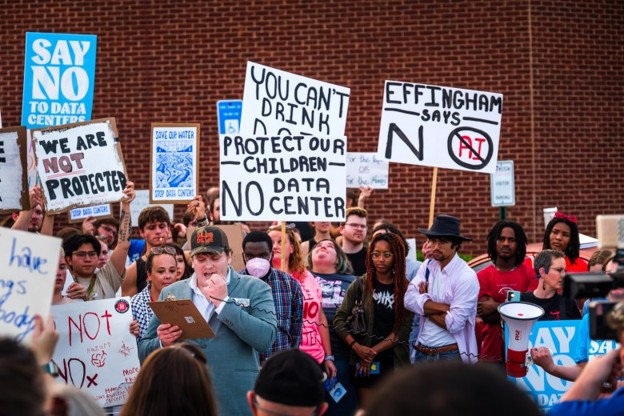
Protest at the Effingham College and Career Center parking lot, where the OpenAI open house was held. Image Credit: Justin Taylor for The Current/CatchLight/Report for America
The open house on July 23 at Effington College and Career Academy was covered in part by The Current, who noted that the 1000-plus person turnout at the event was accompanied by a roughly 300-person protest in the parking lot, with attendees coming from both sides of the political spectrum. A Democratic Party candidate for the 1st Congressional District, Amanda Hollowell, joined them.
County Commissioner for District Two, Republican Roger Burdette, was quoted by The Current saying that the county’s commissioners had no influence over, despite being responsible for nominating the members of the Development Authority. He was also part of a trip paid by OpenAI to visit their Abilene data center in Texas.
“You should trust us,” he told residents.
But local residents from both sides of the political divide voiced their displeasure. When Burdette said that the residents only cared because the development happened to be a data center, Scott Gordy, a retired paper mill worker and self-professed Republican, responded with, “Yes, because that’s an issue that we care about. Haven’t you been paying attention?”
Larry Holloway, who accompanied Gordy and also a self-declared Republican, told The Current, “Why would they think they can decide our future in secret and not feel any consequences?”
Another resident, Scott (no last name was given) vowed to vote Democrat for the first time in protest, saying, “Commissioners need to remember that they work for us, not for themselves.”
A Change.org petition to cancel the data center was put up on July 22, attracting 7000 signatures that same day. At the time of writing, October 14, the petition now has 23,585 signatures.
Future Projections
On Sept. 16, the Coastal Regional Commission of Georgia released a 44-page report on the regional impact of the planned data center. It noted that 30,000 gallons of water would be consumed a day despite the closed-loop cooling system but neglected how much water would be needed for the first-time top-off of the waste-minimizing closed-loop system. County Manager Tim Callanan offered an estimate of, “25 million gallons to fill up everything.”
But The Current cited Professor Kelly T. Sanders from the Department of Civil and Environmental Engineering at the University of Southern California, who pointed out that the closed-system of cooling compensates the decrease in cooling by blowing industrial fans on the pipes, increasing power draw. She therefore presented 4 to 8 billion gallons a year from the associated consumption by power generation, assuming that the data center would only use that capacity 80% of the time.
You can reach the Effingham County’s public outreach office at publicengagement@effinghamcounty.org, or 912-754-8080. Alternatively, you may find a list of the county staff, including the county manager, board of commissioners, and clerks here, under the “Search the Directory” searchbar and by clicking “People.”
You can find Savannah’s Mayoral office at mayorjohnson@savannah.gov, or 912-651-6444.
Send them your comments. Send your questions. But absolutely make sure the government hears what you, the public, have to say.
